In my ongoing microexpressions and Forensic Emotional Awareness training, as per the hit show Lie to Me, I came across this fleeting microexpression from Tony Blair during the Leveson Enquiry in the first second of this video (hint: you can click the image for a bigger size).
00.01 I didn't concede on policy at all
This one-sided smile is a clear sign of contempt mixed with pleasure. Contempt can, after all, be pleasurable. But is Mr Blair lying here? Difficult to say as we can’t say for certain what he is expressing contempt for, long-forgotten battles, the question, himself or the interrogator perhaps?
What is certain is that many politicians, at all levels, are adept at manipulating the truth, often for political reasons, sometimes because of hidden motives and sometimes just to hide their expenses. So, over the next few weeks I’m going to up my game and dissect the Leveson enquiry and participants, many of whom are adept manipulators of public opinion.
That’s a writer’s way of saying professional liars. Do forgive me.
Tony Blair, for example is a well polished performer. His famously stilting speech patterns, which were a form of controlling what gets processed by the listener’s brain, are curiously absent here. I’ll cover how that speech pattern works in another post. But, just watch the next two minutes of video below and you’ll see a range of mixed emotions, and then we find this little gem after the protestor breaks in to make his claims.
Mr Blair tries to defend himself. First, he says: “I’ve never had a discussion with them (JP Morgan) about that (the bribery accusations).”
Then just after 02.20 we see the following unconscious smile start as he says: “Or any relationship between them and Irag…” And by the time he’s finished this sentence, he’s turned away to hide the smile and what appears to be a momentary cheek flush. Here it is in four frames grabbed in quick succession.
02.21 No smile baseline
02.22-3 Smile begins
02.23-4-The turn away
02.24 back in control post blush
So, is Mr Blair lying here? Again context is everything, he could just be embarrassed at feeling he needs to answer a protestor’s accusations, or he could be hiding something after all.
Then just before Leveson says, “You’re entitled to say what you want,” there’s this little flash of anger:
02.28 You're entitled to say what you want
Note the rolled in lips, a tell-tale sign of anger, and what Dr Paul Ekman calls a very “reliable muscle” as it’s hard to do consciously. But anger at what? Initially my politician-sceptical bias made me think it was Blair reacting to Leveson’s interruption and taking offence. But is that my bias, what was really happening, or something else? I’ll be taking a masterclass on this later in the year with Ekman International and hopefully after that I’ll have a clear structure for getting to the heart of it.
There’s also a possible mix of surprise in this last frame, note the raised brows and the jaw drop (mouth closed).
You can watch the full video below or check out the press release from the original YouTube video-poster on Blair’s relationship with JP Morgan.
The science of emotional awareness and Lie to Me is starting to become second nature. The other night I was watching an old episode of The Actors Studio with Robert Downey Jr (a quality actor). He was being quizzed by James Lipton on his court cases and time in jail. I was busy establishing RDJ’s baseline when something struck me. I could recognize some of the microexpressions that were appearing on his face unbidden as Lipton asked him questions about this painful time.
At around minute 19, when talking about prison, Robert Downey Jr’s first microexpression is anger at the judge’s harsh sentence:
RDJ’s second microexpression is sadness at remembering his time in prison (with a hint of fear perhaps?).
Then on reflection a few moments later this third microexpression which doesn’t fit into the microexpression definitions exactly still tells us a lot.
Paul Ekman’s book Emotions Revealed tells me it’s more of a subtle expression of worry, a mix of expressions. It’s so brief, it took me several goes to catch the frame on youtube. So does this all mean that Robert Downey Jr was lying to James Lipton in this interview? In this case, not at all, it simply reflected his internal emotions about the subject. The angry expression is particularly revealing as he doesn’t say explicitly how he felt about the subject. But is he angry at the judge or the sentence?
My notes tell me that RDJ’s baseline at that moment was: “He has one eyebrow, his right, lower than the other. Looks around suspiciously at the audience half the time and has a tongue tick.” not complete by any measure.
Baselines, subtle expressions and the seven microexpressions are all subjects I’ll be covering in future posts. For now, it’s rewarding to see how these real-life Lie to Me skills are becoming a part of me.
You can watch the full interview below, this segment starts at around 19 minutes.
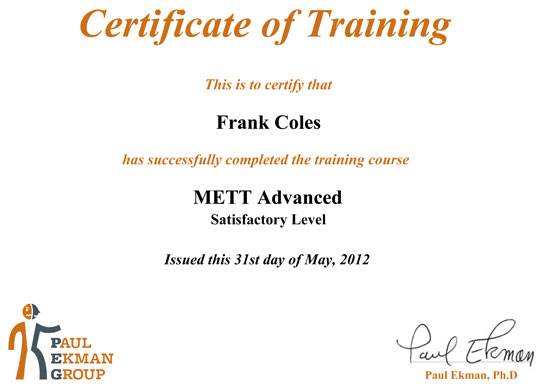
For those of you who are curious this is what the certificate from the Paul Ekman Group looks like for completing the Microexpressions Training Tool (METT). It’s three months before I can take it again when I’ll be aiming for my expert 95% grade.
Welcome back, in the previous post, Get in Their Faces, we discussed the need to be able to observe other people’s reactions more effectively and how we often need to overcome our learned aversion to looking people directly in the face (especially difficult for men it seems, even though Cal Lightman makes it look easy). We need some real-world microexpression exercises to make this happen.
First off, let’s see what we normally do: the learned dynamic in Q&A scenarios or general chit-chat is:
1. Ask a question -> 2. Avert gaze until a change in the person being questioned’s voice tells us it’s time to -> 3. Look back and ask next question.
So, obviously what we want to change is this middle phase, we want to be able to observe the person in front of us without them feeling uncomfortable. The first thing you need to do is ask yourself, what do I currently do during phase two now?
EXERCISE 1: Observe Yourself
This will depend on what your working and home life is like, if you work in a customer facing environment and see a range of people all-day everyday then this won’t take long. Probably no more than a day. But if you’re in a solitary job, or at home a lot, give yourself 1-2 weeks to do this or, alternatively, actively put yourself in positions where you interact more over the next few days.
Then memorize the 1, 2, 3, dynamic above and observe what you do in this middle phase. Do you look away? Do you find it easy to look back? Do you find it extremely difficult, almost painful (as I did), to look back? What happens if you do look back? Can you only look back for a moment? Or are you already able to look people in the face comfortably without you or them becoming upset?
Whatever you observe there is no right or wrong with this, it’s simply what we need to establish before we move onto exercise two.
EXERCISE 2: Unleash the Watcher
During exercise one you will probably have tried to make yourself look back during phase two. You’ll find over repeated attempts that the easiest way to succeed at this is to make yourself relaxed and then allow yourself to simply observe what you’re doing without judgement. People who meditate, go for long walks, run, climb, or shoot will be good at this, or any activity where relaxed concentration, attentiveness as Dr Ekman puts it, is required.
If you’re finding it difficult as I was. Then attempt it for a few days, stop, and then come back to it. Don’t make every conversation a battle of wills with yourself, it’ll only be counter-productive. What really cracked it for me was taking a break for a few days then coming back to it with my partner – she’s a high level corporate negotiator. She told me that many years ago during her negotiation training each candidate was videoed and their poor-negotiation habits were highlighted and they had to work on them if they were to succeed. One of them for her was not breaking eye-contact repeatedly. As eye-contact and staring can be used to intimidate others during negotiation. She was given this simple little meme to work with: “Don’t be afraid to maintain eye-contact”.
Try it. Next time you look away, challenge yourself. Don’t be afraid, maintain eye-contact.
EXERCISE 3: Get in their faces without getting a punch in yours
Okay, so we’ve observed our learned style of observation, we’ve unleashed the watcher within, and we can maintain eye contact through a good part of phase 2. But what happens if the other person becomes uncomfortable, defensive, aggressive, or even violent? Most likely the person you are talking to will simply avert their gaze if they feel uncomfortable, but depending on who you’re talking to the results could be very different. A bouncer may give you a totally different response to a librarian for example. And maybe not what you’d immediately think!
Basic Technique: Soft vision
Look but don’t stare. Let your eyes move around the face in a relaxed manner. Neither too quickly, as if you’re disinterested, nor too slowly so that you’d don’t zone out or stare.
Advanced Technique: Use your vision systems
Most people aren’t aware that we have two different ways of seeing. From our days as hunter gatherers we have what we commonly know as central and peripheral vision systems. If you imagine the peripheral vision was what we used when we were scanning the landscape for prey (mobile or static), the central (sometimes called tunnel) vision system was what we used when we found our prey, zeroed in and chased it – or even ran away from it. Central vision causes our heart rate to elevate, our palms to sweat and our systems to go into fight or flight mode. If someone was glaring at you and looking twitchy how would you feel?
Peripheral vision on the other hand is a restful state which allows our unconscious to do most of the work and calms our inner monologue. Most of us are familiar with central vision, we use it all the time to watch TV, use our phones, use computers but during observation it helps to be able to switch between the two. There are many emotions at play on the face, using peripheral vision you can scan the face and zero in when you need to and back out again. Learning to use this system also helps with your stress levels and will make you look less of a nutter when you’re ogling someone for signs of emotional leakage.
EXERCISE 4: Peripheral Vision
Gaze gently on a point directly in front of you. Then expand your awareness as far to edges of your vision as is possible. Begin to discern objects, without forcing it. What you can see? Keep practicing this until it feels comfortable. In a quiet room where nothing is going on you won’t always notice that much, but take your peripheral vision out for a walk and you’ll be amazed by what you can see. See how far back you can move your perception. Can you see behind you? What animals are you aware of? What vehicles? Any objects that aren’t moving?
What's she thinking? Can you guess?
Now when you’re looking at someone’s face, staring, whether from central or peripheral vision, will be unnerving to the other person. Instead gently change between the two systems, you’ll be more relaxed and more able to see what is going on. Again this is a technique that gets easier with practice. It will also help you relax due to the instant changes in your nervous system that the hunter vision gives you. It’s such a powerful technique that it’s taught to elite team-sports players and martial artists, so that they are more aware of what’s happening on the playing field or mid-fight. For a simple practice that often requires extraordinary active peripheral vision, try juggling.
These are the basic real-world microexpression exercises I’ve developed that work for me and those around me – at least for putting microexpressions into action.
I’ll be putting together a cognitive behavioral therapy worksheet that should help anyone who gets stuck on these in-their-face exercises. Some of these learned behaviours can be very hard to break. To give you an example my 21 month old son has only recently started to look away during conversations and it takes a good 10 days for the little guy to unlearn any habit. At it’s most basic avoiding eye-contact means he doesn’t have to acknowledge what’s going on around him, but also it’s probably what he sees every day. So stick at it and you’ll get it.
If there’s anything you’d like me to expand on please drop me a line in the notes below.
In the coming weeks we’ll be looking at Dr Ekman’s seven universal emotions and seeing how many you can spot while using the above techniques. Take another look at the pictures on this page, what emotions do you think are on display? I scoured several photo libraries with emotion keywords and nearly all photos available are mislabelled, which means that even photographers – people who look at faces every day – don’t necessarily know what they’re looking at. Answers in the next article, but I’d love to hear your guesses!



 by
by 




 Writer, Entrepreneur, Speaker, Father.
Recent Comments