In my ongoing microexpressions and Forensic Emotional Awareness training, as per the hit show Lie to Me, I came across this fleeting microexpression from Tony Blair during the Leveson Enquiry in the first second of this video (hint: you can click the image for a bigger size).
00.01 I didn't concede on policy at all
This one-sided smile is a clear sign of contempt mixed with pleasure. Contempt can, after all, be pleasurable. But is Mr Blair lying here? Difficult to say as we can’t say for certain what he is expressing contempt for, long-forgotten battles, the question, himself or the interrogator perhaps?
What is certain is that many politicians, at all levels, are adept at manipulating the truth, often for political reasons, sometimes because of hidden motives and sometimes just to hide their expenses. So, over the next few weeks I’m going to up my game and dissect the Leveson enquiry and participants, many of whom are adept manipulators of public opinion.
That’s a writer’s way of saying professional liars. Do forgive me.
Tony Blair, for example is a well polished performer. His famously stilting speech patterns, which were a form of controlling what gets processed by the listener’s brain, are curiously absent here. I’ll cover how that speech pattern works in another post. But, just watch the next two minutes of video below and you’ll see a range of mixed emotions, and then we find this little gem after the protestor breaks in to make his claims.
Mr Blair tries to defend himself. First, he says: “I’ve never had a discussion with them (JP Morgan) about that (the bribery accusations).”
Then just after 02.20 we see the following unconscious smile start as he says: “Or any relationship between them and Irag…” And by the time he’s finished this sentence, he’s turned away to hide the smile and what appears to be a momentary cheek flush. Here it is in four frames grabbed in quick succession.
02.21 No smile baseline
02.22-3 Smile begins
02.23-4-The turn away
02.24 back in control post blush
So, is Mr Blair lying here? Again context is everything, he could just be embarrassed at feeling he needs to answer a protestor’s accusations, or he could be hiding something after all.
Then just before Leveson says, “You’re entitled to say what you want,” there’s this little flash of anger:
02.28 You're entitled to say what you want
Note the rolled in lips, a tell-tale sign of anger, and what Dr Paul Ekman calls a very “reliable muscle” as it’s hard to do consciously. But anger at what? Initially my politician-sceptical bias made me think it was Blair reacting to Leveson’s interruption and taking offence. But is that my bias, what was really happening, or something else? I’ll be taking a masterclass on this later in the year with Ekman International and hopefully after that I’ll have a clear structure for getting to the heart of it.
There’s also a possible mix of surprise in this last frame, note the raised brows and the jaw drop (mouth closed).
You can watch the full video below or check out the press release from the original YouTube video-poster on Blair’s relationship with JP Morgan.
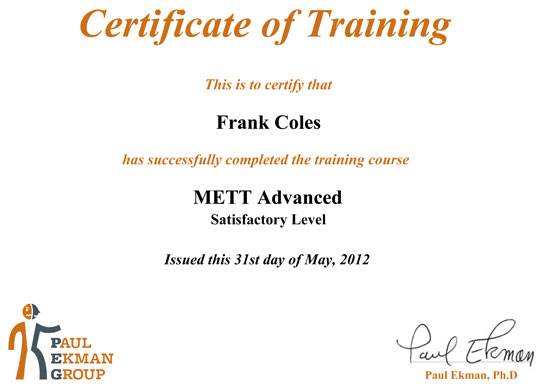
For those of you who are curious this is what the certificate from the Paul Ekman Group looks like for completing the Microexpressions Training Tool (METT). It’s three months before I can take it again when I’ll be aiming for my expert 95% grade.
On a lighter note. I just retook my microexpressions training tool test and got it up to 82%, which is certification level. I worked hard on it during a recent holiday and can get 100% in the practice sessions but my main problems still stem from mis-recognizing sadness as anger and understanding the differences between genetic types and individual emotional baselines.
Which means I can’t see the wood for the trees sometimes! But hey, practice will make perfect, and I’m aiming for my 95% expert completion in the next test window three months from now. I’ve been chatting on this blog with Cliff Lansley – Director of the Emotional Intelligence Academy here in the UK – Dr Ekman’s affiliate – and came across this Youtube video of one of his early seminars. It makes for very interesting reading. And has got me thinking about how lying shows up in writing. Many of the things he lists here as signs of lying in verbal and body language are also signs of lying in written English, I’ll write more on this in coming posts, but for now enjoy the video of the illustrious Mr Lansley in action.
Cal Lightman visits underground fights so that he can stay sharp on how people express or hide their emotions. There’s good reason for this, emotional awareness skills need to be refined and refreshed regularly.
For example, one thing that becomes apparent when you use the microexpressions training tool (METT) over time is that each person’s neutral expression is slightly different and sometimes their neutral baseline can even look like an emotion.
How is that possible? Well, some people have naturally droopy faces and so look naturally more sad, or more rounded eyes and lips that can easily mimic surprise.
Genetic types also throw up their problems. It could be that the fuller lips of someone of african origin make you mis-read sadness (the downward turn can be less obvious than in thin lips). Or that the sometimes non-existent eye brows of Asians, or even fanatical pluckers, hide the same emotion because you can’t see the brows coming together. And it’s just as easy to miss anger in the thin lips of many caucasian genetic types.
This woman's neutral expression has hints of other emotions. Could you tell the difference?
The only way I’ve found to get round this is to familiarize yourself with specific genetic facial features. If you live and work in an environment where one genetic group dominates you may find this difficult. The METT tool can help if this is the case as you can freeze emotions you’re uncertain of and rapidly click them on and off to train your unconscious what to look for.
Alternatively you can find cultural mixes and good people to watch in a range of different places…
Holiday resorts
Hospitals
Libraries
Public Transport – trains, planes, buses and so on.
Cafes and bars
I’ve particularly found the first two to be excellent. The first because of the range of different cultures on display – it very quickly became obvious at a resort in Crete recently that the Russian guests, as a social group, have a more serious, even slightly angry, baseline. There could be many reasons for this, from the social class/history of Russians that can afford such holidays, to their regional backgrounds or the amount of sleep they take. Definitely an area for more study.
Hospitals, I only found out today, are particularly good. There are lots of great studies in those waiting rooms, from lots of cultures, classes and of varying ages. They each have their own way of handling anxiety if they are patients, some get angry, others happy, others scared. And if they are partners or family their support style differ as well – some just spout BS and platitudes, some genuinely care.
What was obvious from this morning’s range of emotions is that anywhere where you can find strong emotive environments is going to be productive, usually where there is risk, danger, fear or social masking are probably the best places to try. Now, I wonder if there are any underground fights in my local area?
Sometimes you've just gotta get your hands dirty
So do Russians smile? You bet they do, when I’ve worked with Russians in their own territory, all the time. But as expats or tourists outside their comfort zone I’m not so sure.
I’ve been interested in liars and lying for a long time, ever since a situation where I realized people close to me had been deceiving themselves and me for years. I’ve read and studied books on how to spot the lie and the liar, there’s a lot of information out there from body language and persuasion skills, to NLP patterns and interrogation techniques. But one of the most interesting techniques has to be spotting microexpressions as per Dr Cal Lightman in the TV series Lie to Me.
Tim Roth’s character is a deception expert who uses the momentary unconscious microexpressions we all exhibit to tell when people are lying. They boil down to Anger, Disgust, Fear, Happy, Sad, Contempt, Fear and Surprise. This fictional character’s abilities are actually based on real-life Dr Paul Ekman’s work. So I decided to give his online training tool a go, arguing to myself that these seven emotions were surely just what we teach children, everybody knows them, how hard can it be?
I first tried the demo and scored a measly 21% emotion recognition. I was shocked. The only emotions I could readily recognize were anger, disgust and happiness. It was a profound realization that I’m not emotionally aware as I think I am. I confuse sadness with anger – which explains, for example, why if I can’t make a sad person laugh straight away I basically get angry back at them. Appease the aggressor, then attack.
I signed up on the spot. Within a half hour’s training I could spot more emotions easily.
While dropping my son off at nursery I saw the straight lips and straight eyebrows that indicate fear. He regularly gets separation anxiety – the fear that his dad/mum won’t come back. It’s made me change the way I drop him off – rather than go in the car, I now walk him to nursery in the pram, we chat to his mum for part of the way, spot buses, dogs and birds and he’s generally a bit less anxious when we get to nursery – no tears this morning – a bit of bottom lip mind. But I’m working on it.
Interestingly I saw disgust on one of his little friend ‘s faces when I said hello to her in the morning, but when I saw her in the afternoon she couldn’t stop smiling at me. What this has already taught me is that as well as spotting deception you can respond much more to what those around you are feeling. But only if you don’t take the observed emotion personally and use it to understand the person’s needs.
The training is basically a series of neutral photos followed by one of the seven emotions. In training this is done at slow speed with voice over explaining what to look for. In the pre-test you set the speed of the flashed emotions. I settled for the highest speed and improved my score to 61%. A comprehensive review and then I tried the full test. I scored 71%. That’s 100% on happy, disgust and contempt. But 0% on things like sadness. It’s a bit of a kick in the teeth to realize that as a 39 year old adult, I can’t recognize sadness in others (at least for split-second micro expressions, if you were blubbing in front of me right now, I’d catch your drift!).
It’s interesting and profound training and it reminds of some of the childcare books and flash cards that encourage you to teach emotions to your children. The program tells you to not take the test for another three months so that you don’t become overly familiar with the faces and predict the responses from memory.
That’s a good tip if you genuinely want to progress, although I would recommend going over it 24 hours later (minus the test) as well.
Sleeping on it, and then coming back to a subject when you’ve almost forgotten it are two scientifically proven ways of increasing your skills and recall.
If you get 80% in the test you’ll get a certificate of competence, if you get 95% you’ll get an ‘Expert’ certificate. I think the test and training could be improved by properly randomizing the final test with a baseline photo then morph to the emotion so that you can repeat it more quickly, other than that, I’m sold on the emotional recognition idea and looking forward to getting my Expert cert – one day!



 by
by 




 Cal Lightman visits underground fights so that he can stay sharp on how people express or hide their emotions. There’s good reason for this, emotional awareness skills need to be refined and refreshed regularly.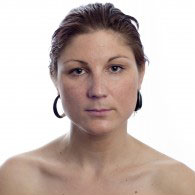


 Writer, Entrepreneur, Speaker, Father.
Recent Comments