
How to Lie to Me: Do Russians Smile?
 Cal Lightman visits underground fights so that he can stay sharp on how people express or hide their emotions. There’s good reason for this, emotional awareness skills need to be refined and refreshed regularly.
For example, one thing that becomes apparent when you use the microexpressions training tool (METT) over time is that each person’s neutral expression is slightly different and sometimes their neutral baseline can even look like an emotion.
How is that possible? Well, some people have naturally droopy faces and so look naturally more sad, or more rounded eyes and lips that can easily mimic surprise.
Genetic types also throw up their problems. It could be that the fuller lips of someone of african origin make you mis-read sadness (the downward turn can be less obvious than in thin lips). Or that the sometimes non-existent eye brows of Asians, or even fanatical pluckers, hide the same emotion because you can’t see the brows coming together. And it’s just as easy to miss anger in the thin lips of many caucasian genetic types.
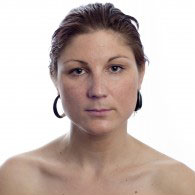
This woman's neutral expression has hints of other emotions. Could you tell the difference?
The only way I’ve found to get round this is to familiarize yourself with specific genetic facial features. If you live and work in an environment where one genetic group dominates you may find this difficult. The METT tool can help if this is the case as you can freeze emotions you’re uncertain of and rapidly click them on and off to train your unconscious what to look for.
Alternatively you can find cultural mixes and good people to watch in a range of different places…
- Holiday resorts
- Hospitals
- Libraries
- Public Transport – trains, planes, buses and so on.
- Cafes and bars
I’ve particularly found the first two to be excellent. The first because of the range of different cultures on display – it very quickly became obvious at a resort in Crete recently that the Russian guests, as a social group, have a more serious, even slightly angry, baseline. There could be many reasons for this, from the social class/history of Russians that can afford such holidays, to their regional backgrounds or the amount of sleep they take. Definitely an area for more study.
Hospitals, I only found out today, are particularly good. There are lots of great studies in those waiting rooms, from lots of cultures, classes and of varying ages. They each have their own way of handling anxiety if they are patients, some get angry, others happy, others scared. And if they are partners or family their support style differ as well – some just spout BS and platitudes, some genuinely care.
What was obvious from this morning’s range of emotions is that anywhere where you can find strong emotive environments is going to be productive, usually where there is risk, danger, fear or social masking are probably the best places to try. Now, I wonder if there are any underground fights in my local area?

Sometimes you've just gotta get your hands dirty
So do Russians smile? You bet they do, when I’ve worked with Russians in their own territory, all the time. But as expats or tourists outside their comfort zone I’m not so sure.
Go back to the first article: How to Lie to Me: Real-World Microexpressions Training


 by
by 
 Writer, Entrepreneur, Speaker, Father.
Recent Comments